
Gourds and Twisters – My Book AAN ZEE Comes Alive

.
In my blog about Reading Moby Dick I commented on the sorcery that seems at play spawning events in the physical world from concentrated mental states. In the same vein I can report on two recent materializations of fictional ideas articulated in my novel AAN ZEE, which appeared seven years ago, but were already contained in the book’s manuscript for at least another 25 years before the day it was set to print.
[For clarification, important to understand certain aspects of the story, the book AAN ZEE appeared in three editions, each with minimal circulations. The first was published by The University Press of the South in 2019 with a cover designed by me showing an Impressionist painting of woman on a seaside promenade; the second appeared in 2021 without my authorization, following an attempt by the editor to open a market for the unchanged book in Europe bu using a different cover, showing a path over sand dunes leading to a generic beach, and the third edition with the more explicit title HOTEL AAN ZEE, OR THE TURBULENT FORCES OF LOVE, with some alterations of the text and a redesigned cover, this time showing a woman with flowing hair looking at the riling sea at dusk. This last edition was self-published, after my discovery that the press I had published with did not exist as a legal entity at the time I signed a contract with a person claiming to represent it in 2018. It seemed important to create an edition with undisputable legality so would have all the rights, including the rights to authorize translations. A translation into Chinese was on the horizon, and in 2025 the interested party had already contacted a publishing house in China.]
To fully appreciate the audacity of these coincidences the reader of the blog must read the book in any of the three editions – the current entry serves as a mere pointer for those already educated.
Item one concerns a subplot in the book, namely the business of a man called Eric, friend of the protagonist Hubert, driven with the idea of starting a farm to raise gourds in molds so that they gain the appearance of prominent historic personalities, such as Abraham Lincoln or Albert Einstein. Important for understanding the following quote, Eric is confined to a wheelchair on account of an accident as a child. Chapter 3, which introduces him, contains this paragraph:
“The sculpted gourds—fantastic as they were, successful or not as a commercial venture—would contribute to Eric’s spiritual survival. In some way, the idea with the gourds was a phallic dream, a dream of swelling, filling, giving life, impressing one’s form on unformed substance. By filling the molds, Eric would fill the world with his presence; he would finally overcome the constraints of his condition. Like a tree that produces wind-borne seeds, he’d send out messengers who would travel for him and testify to his ingenuity, strength, and prolific energy wherever they would go.”
Unfortunately, the business Eric started runs into repeated problems because of bad weather and hailstorms, leading each time to pleas for additional loans from Hubert.
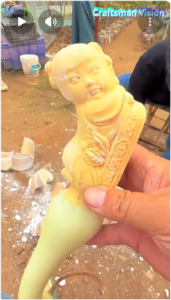
So far, this is my account of the subplot of my novel. Fully convinced that the idea of growing gourds into heads with recognizable faces was mine I was rattled to find a video on youtube showing a Chinese man cracking open a form attached to vines, to reveal a beautifully shaped head with a finely sculpted face in the historical Chinese tradition. For a few hours I was furious, convinced that the idea had found its way from the Chinese publishing house to some entrepreneurs who did not bother to acquire a license.
That is, until my internet search revealed that growing gourds in molds to form heads with faces and heraldic tableaux is an ancient Chinese technique, which I apparently had re-invented from scratch. In China, the molded gourds would then be scooped out and dried, leaving corrugated wooden-looking heads with eerie visages.
Item two is related to the fact that I had to give the scientist protagonist a discipline different from mine, so as to avoid the impression that the book is nothing but a fictionalized autobiography. The discipline I chose was the theory of turbulence and chaos, as applied to meteorology and climate studies. Turbulent is in fact an adjective in the title of the third edition, albeit associated with love.
In chapter 1, Hubert Belovski, protagonist of the novel, is credited with a monograph entitled “A Twister’s Sudden Birth,” and subtitled “The Onset of Turbulent Phenomena in Meteorology.”
Here is Hubert’s ab initio characterization in chapter 2:
“The Big Bang—matter freeing itself from its timeless existence in singularity, expanding in centrifugal motion, exploding into the new (as yet unheard of) dimensions of time and space—produced gravity and force fields and interactions that reached far out into the cold, empty space, differentiating, clustering into stable states, condensing, condensing, creating conditions for complex systems to form—temporarily, at least—that were able to replicate and pass on their acquired sophistication over generations and to accommodate to the hardships of the emptiness around and the hostility of matter not so organized: living, organic matter—to come finally to the point God was waiting for: slime molds, baker’s yeast, white radishes, purple snails, and angora rabbits—and some unknown force pushed some of these temporary organic beings ahead of others, creating humans—violent animals with brains to argue and boss everyone else around—and specifically, after many trials and errors over thousands of years and after many successes at creating non-Huberts, finally created Hubert Belovski, the one who felt the centrifugal pull (a red-shift within himself) every night when he lay awake in his bed made of wood (dead flesh of his green fellow plants!) and listened to the shrill comforting sounds of the cicadas (living flesh of his antennae-bearing sensitive and sentimental fellow souls!). And in the grand picture that presented itself to Hubert for a fleeting moment, it seemed odd that he didn’t spend every living second rejoicing over the unique path of fate that had brought him into existence. Instead, circumstances had forced him to work, and the particular work he had chosen for himself was to study the swirls, funnels, and maelstroms in which nonorganic but nevertheless fellow matter (air and clouds and dust) preferred to move around in the atmosphere.
A cosmic joke?”
Now to the promised account of the incarnation of this fictional character in the physical world: a few days ago I participated in a large tech conference in New Delhi. A plenum lecture I attended was given by an eminent scholar from Oxford whose field of study fits the description in my book exactly, as if I had conjured him by the sheer force of my imagination.
But this is not enough of a coincidence, since recently AI has purportedly solved the Navier-Stokes existence and smoothness problem, which has to do with the formation of instabilities – twisters — in the flow of incompressible fluids when a smooth external force is applied. This claim, made on September 8, 2026, is disputed by mathematicians who have been working on the problem for years, and who claim that this is a scoop of truly millennial proportions as AI’s internet tentacles sneaked into drafts of a nascent human solution.
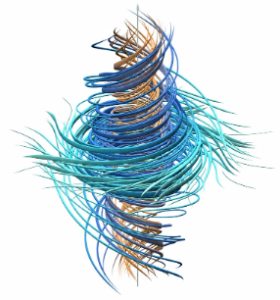
Admittedly, this last addition to premonitions in my book is a stretch since air, the substance where weather phenomena are at play, is far from incompressible, and twisters are such a common experience that AI might not bother to deal with it.
.
.

Leave a Reply