
Reading Moby Dick

.
As an outsider, European-based, I used to regard Moby Dick as a curiosity, no longer relevant in our time. The little reading I did years ago – it must have been in the 1970s – a few pages into the 800-page tome of a book was bewildering to me and did not whet my appetite for getting deeper into this book. (I found out that my reaction was similar to those of the readers 170 years ago but for an entirely different reason).
But little by little Melville managed to encroach on me as I found out that he spent part of his childhood in Albany – the place where I spent more than 30 years of my life – while his father tried his luck in the fur trade. Young Herman attended the Albany Academy, just across from the Girl’s Academy where my daughter went to school for her first years. And my imagination was kindled when I found out that during the time when the novel took shape Herman Melville was living at a peaceful place – a farm he had expanded and called “Arrowhead” – where he saw, looking out the window each day, the massive shape of Mount Greylock, near North Adams, whose profile resembles that of a big whale. He lived there for 13 years with his family, and this is where he wrote the majority of his books.

My forays into American literature have something in common with those I undertook as a physicist into biology: just glimpses into a rich tapestry of subjects disconnected from one another by wide gaps. The outcome in both cases is the fractured universe of an autodidact. Moby Dick was somewhere in one of those gaps, but it was the last one I would have considered of interest exploring. I now see, with the eyes of someone who attended Joseph Luzzi’s brilliant lecture at the Historical Society of New York – I will come to this – what distanced me so from this text: the passages of almost ancient-sounding language, sometimes Shakespearean and sometimes Biblical. It seemed to me a voice long obsolete, and with the focus on a trade long gone, preying on the most majestic creatures on this planet in the cruelest way. (The protection of whales is close to me heart as long supporter of Greenpeace).
At the time I took these mental notes, newly arrived in America, I was not attuned to the subtleties of English prose; I had yet to find my own voice as I listened to the voices of others. William Kennedy, Eugene Garber, and Steve Millhauser, masters of fiction writing I took classes with, taught me to the art of listening, reading and writing. Still, Moby Dick was an oddity I could not connect with the body of literature that came after its appearance in 1851.
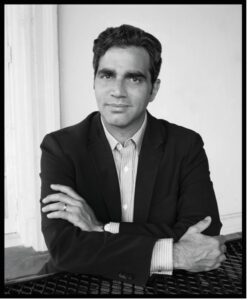
The lecture by Joseph Luzzi, professor of literature at Bard College, changed all that. It was the second lecture in the series “The Story of America in 7 Books” at the New York Historical Society. The series was heralded by this statement on its website:
“The Great American Novel remains the ultimate literary pursuit, a quest to distill the sprawling, contradictory soul of a nation into a single, definitive narrative. Today, as we reflect on two and a half centuries of storytelling, this literary tradition stands as a vital mirror to the conflicts and triumphs that continue to shape what it means to be American.”
Most importantly, I gained an appreciation from his lecture of Melville as the early originator of the experimental novel. Indeed, all writers coming before him, with the possible exception of Jonathan Swift and Miguel Cervantes, had created works of fiction that was self-contained, and without revealing the emotions, frustrations and struggles of the author. But Melville’s prose still sets him apart from those exceptions as his story telling is manic, prefusive, encumbering the storyteller on each level of their human existence.
To the question by someone in the audience who among writers that came after Melville was influenced by Moby Dick, Luzzi’s answer was that it was difficult to find someone who wasn’t. At that point it dawned on me that all the compelling 2oth-century novels I ‘d read had this in common: a convoluted perspective in which the writer/narrator and their arbitrary choices of tone, subject and personal engagement are not concealed from the reader. In recent examples, look at Jonathan Franzen and Ben Lerner.
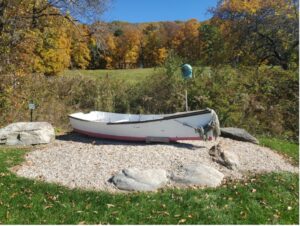
AHAB – sculpture (wood, rope, bronze head) by Matt Thomases
As often happens, mental concentration on a subject over a prolonged time conjures its encounter in the physical world. Case in point is my encounter of Ahab in Matt Thomases’ Berkshire Hills Sculpture Garden. The sculptor says of his creation “AHAB” – a bronze head mounted high on a retired New England boat –
“This sculpture was created in the late 1980’s after I re-read Moby Dick. In Chapter 28, Ahab is described for the first time through Ishmael’s eyes. My drawings for the sculpture were made as I struggled to internalize words,
‘His whole high, broad form seemed made of solid bronze, and shaped in an unalterable mold, like Cellini’s cast Perseus.
‘So, powerfully did the whole grim aspect of Ahab affect me, and the livid brand which straked it, that for the first few moments I had hardly noted that not a little of his overbearing firmness was owing to the barbaric white leg upon which he partly stood.
‘I was struck by the singular posture he maintained…
‘There was an infinity of firmest, fortitude, a determinate, unsurrenderable willfulness, in the fixed and fearless, forward dedication of that glance.’”
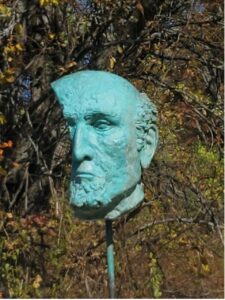
Detail of AHAB, by Matt Thomases
“His whole high, broad form seemed made of solid bronze” – Ishmael in Moby Dick

Leave a Reply