
Celebrating the 250th Anniversary of the Knox Trail

.
On January 10, 2026, people from Alford, Massachusetts and surrounding hamlets, villages and towns gathered at a point where 250 years ago, in the middle of winter, an extraordinary military cavalcade of horse-drawn sleds carrying 51 cannons and two howitzers passed on their way from Fort Ticonderoga to Boston.
This was Henry Knox’ daring, successful attempt to drive the British out of Boston, a move that proved decisive in the struggle of the colonial settlers for independence. Henry Knox was a 26-year old bookshop owner in Boston who had shown remarkable bravery before, and who was entrusted by General Washington with leading the military operation across the Hudson river and several mountain ranges, including the Berkshires, all with horse-drawn, hastily built massive wooden sleds. Early depictions of the journey showed oxen – see the depiction on the bronze plaque below – which were originally planned to be used but could not be procured in the numbers needed.
.
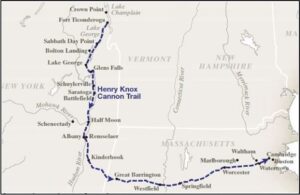
The Knox Cannon Trail from Fort Ticonderoga to Boston, a journey which took 42 days. Once the full-fledged armory showed up in Boston, the occupying force of the English took flight on their ships. (The word “Ticonderoga” comes from the Mohawk tekontaró:ken, meaning “it is at the junction of two waterways”). Fort Ticonderoga was a large fortification established by the British on a hill on the West side of the Hudson and was later seized by American troops. In defeat, the British were unable to secure the large trove of weapons and ammunition, which would now be turned against them. Henry Knox recorded the details of the journey in a diary up to Great Barrington, then stopped keeping notes, so we can trace every move from Ticonderoga to here with high confidence but need to rely on numerous witness accounts thereafter.
The trail went right through Alford, close to the border between Massachusetts and New York State, and less than three miles from my house on Green River Road. The crossing of the road (now named Route 71) was later marked by a concrete slab with bronze plaque.
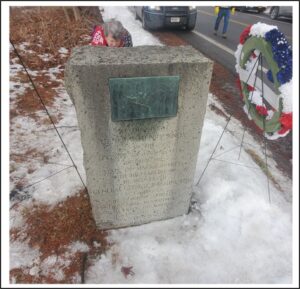
Marker of crossing point on Rt. 71
After a long wait walking around and stomping our boots into the snow to keep warm, representatives of the New York and Massachusetts legislatures, and local governments, and various historical societies, and park administrators finally stepped up to the microphone and gave speeches highlighting the significance of those historical events. Everybody around us agreed that the speeches were overlong and repetitive, but they were all emotional and well-intended.
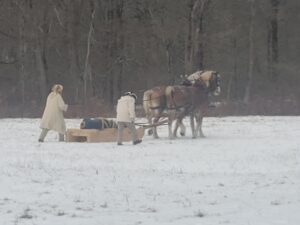
Re-enactment: horses drawing a cannon tied to a sled, directed by soldiers in original costumes
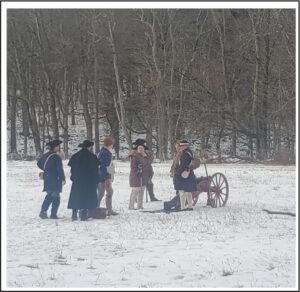
Re-enactment: a cannon is being readied for a shot into the woods
.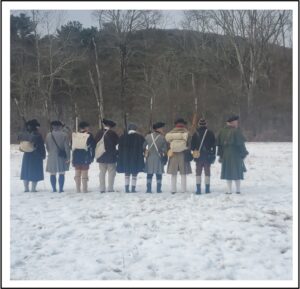
Re-enactment: nine soldiers with rifles getting ready for a salvo
.
.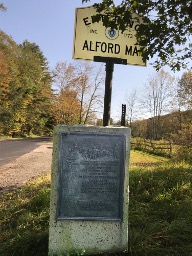
The marker seen from the opposite direction, in summer
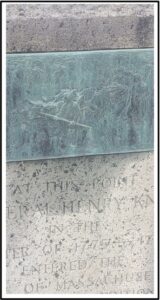
Detail of the Knox Trail plaque in Alford, showing oxen instead of horses
.
.
This entry was posted in Blog and tagged Alford, Boston, bronze, cannons, Great Barrington, Green River Road, horses, Massachusetts, New York, oxen, rifles, Route 71, sleds, washington. Bookmark the permalink.

What a fantastic piece of history. Your write-up really took me right through Alfred’s experience. The re-enactment must have crystallized the imagery for everyone. And wow, a cannon blast too!