
Friedrich Flender, executed as he stood up against injustice

.
Friedrich-Flender Schule, Engsbachstrasse, Weidenau/Sieg
My elementary school, Friedrich-Flender Schule, was across the street from our house in Weidenau/Siegen. I never paid attention to the origin of the name until I found out, a few years ago, that Friedrich Flender, of the Weidenauer Familie Flender in Haardt, was a blacksmith, a local hero as he and his family led a revolt defying extra taxes levied by the duke in 1707. He was arrested after a chase and was executed within three days without due process. To the credit of the Emperor, just another five days went by before the duke was removed and stripped of his duties.
I was surprised when I found out that the website of the school, of my school, makes no mention of the origin of the name. For, in our day and time, the importance of standing up against plain injustice is so strong and vital, and we should honor the memory of those who risked their lives. I wrote a letter to the current director to this effect. But the school does have a memorial plaque that I found on the internet.
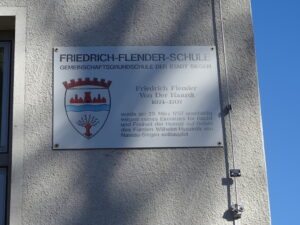
In the ensuing research for this blog I found out that I’m related to Flender from both sides of my family:
- Schleifenbaum, Elsbeth, geb. Flender <sister>, * 1661, married 1678 to Ludwig Schleifenbaum, blacksmith and ironmaster vor der Hardt
- Manskopf, Sophie, geb. Flender <sister>, 1668-1740, married 20.10.1685 to Johann Henrich Manskopf, citizen and council administrator in Siegen, 1661-1745
Amalie Schleifenbaum is the name of my grandmother on my father’s side; Charlotte Manskopf is my mother’s maiden name.
The story below is compiled from Wikipedia, from an account by Hermann Böttger, and other sources on the internet
In 1699, Prince Wilhelm Hyazinth assumed the reins of government over the Principality of Nassau-Siegen.Unlike his predecessors, he did not attempt to coerce the predominantly Protestant population into adopting a specific faith; instead, he extorted them through outrageous tax burdens, which he endeavored to collect with the utmost brutality.He consistently spent far more than he possessed, and in doing so, he bled his subjects dry. Those particularly affected were the wealthy industrialists of Weidenau, who were driven to the brink of ruin.Driven by desperation, they sought assistance from the Emperor (in Vienna), to whom they submitted a litany of complaints and grievances.
Prince Hyazinth made repeated attempts to sell his territory to his Protestant relatives for a substantial sum. He was in constant conflict with his father, Franz Desideratus, and harbored a deep hatred for his other relatives as well. Overestimation of his own abilities, arrogance, and vanity—along with the resulting, almost insane obstinacy regarding matters of his perceived dignity and status—as well as his profligacy, were his constant companions. Furthermore (and most important in the ensuing events), he was plagued by chronic financial difficulties throughout his entire life.
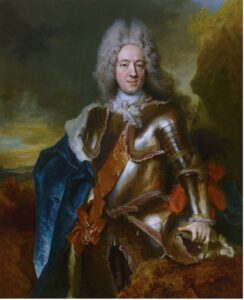
The gruesome Fürst Wilhelm Hyacinth – painting by Nicolas de Largillière (now in the Mauritshuis museum, The Hague)
Hyacinth and his tyrannical associates identified the Flender family as the ringleaders behind the unrest. When Johann Thomas Flender, acting on behalf of his fellow citizens, declared that they could no longer meet the inhumane demands, he was taken prisoner and sentenced to execution. In response, his friends, neighbors, and acquaintances gathered in front of the castle to demand his release. The Prince, blinded by delusion, feared a revolution and dispatched soldiers and cavalry to the Haardt to apprehend the ringleaders.
The castle soldiers did not have their sights set solely on Friedrich Flender. His older brother, Johann Jakob Flender, and his brother-in-law, Johann Ebert Stute, managed to escape to the safety of the opposite bank following a wild chase across the Ferndorf river—at the time, the river marked the border between the Catholic and Reformed territories. The soldiers seized Friedrich Flender while he was out in the fields performing farm work with his hired hands. They beat one of the hired hands until he agreed to bind his master’s hands behind his back. Friedrich’s pockets were then filled with heavy stones to prevent him from running away. In this manner, the prisoner was dragged on foot all the way to Siegen.
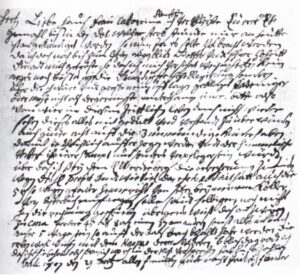
Farewell Letter from Friedrich Flender to his wife
Friedrich Flender was held in custody at the castle for three days. Together with his councilors, the Prince sentenced him to death. Two councilors who dared to object were thrown into prison. He was permitted to write a letter to his wife, who had given birth to twins just three weeks earlier. In this moving letter, he bade farewell to her and to the earthly world. The original letter is preserved in the Siegerland Museum; it was discovered in a wall niche during the demolition of the home of Flender’s widow. On the morning of the third day, Flender was informed of his death sentence.
A few lines from the letter Flender wrote:
“My dearest wife, Catharina Flender! I remain your husband until death, the hour of which has been announced to me today. If it should now come to pass, since I still comfort myself until the last moment in God’s grace and His Highness’s grace, so that I know myself to be assured in my heart. ……………. Therefore, please, if we do not see each other again in this earthly life, to overcome all this with patience and understanding. Also, please take good care of the three minor children, so that they may be raised Christian and the Heavenly Father will be your sole provider. Vale* 1707, March 29th. Good night to all friends, Friedrich Flender.”
[* Vale = Be strong, i.e., farewell!, also: Be blessed!]
On March 29, 1707, by order of the Catholic Prince Wilhelm Hyacinth, Friedrich Flender von der Haardt was beheaded in the Hasengarten—the rabbit garden—at the Upper Castle in Siegen. He was executed without any form of judicial trial. As a deterrent, his severed head was impaled on a pole atop the bastion overlooking the Marburg Gate, facing toward the ironworks. It must have been a ghastly sight. On the morning of March 29, 1707, the severed head of the young industrialist Friedrich Flender was displayed on a pike atop the highest structure in the town. Serving as a warning, the lifeless head gazed down upon the ironworks near Weidenau. This spectacle had been meticulously orchestrated down to the last detail within the walls of the Upper Castle. As early as 1706, the government had threatened all delinquent taxpayers with this very same fate: anyone of means who failed to pay their required levies would have their head struck off and mounted upon the ramparts.
The very next day, his head was taken down once again. It was placed alongside his body in a wooden box and buried—in a manner utterly devoid of humanity—in the churchyard at Weidenau, right up against the wall. Fear and terror spread throughout the land, even more so than before. Both the Reformed and the Catholics were forced to fight for their very lives. News of this wicked, ruthless, and merciless deed committed by the Catholic Prince swept through the entire land like wildfire. Wherever people spoke of it, the unanimous sentiment was that Almighty God would not allow such an outrage to go unpunished. For if He did, it would mean that there was no longer any Judge in Heaven.
The capture and execution of Friedrich Flender must be understood within the context of the religious and political circumstances that prevailed in the Siegerland region, and especially in the Catholic part of the region, around the turn of the 17th century. From the bronze memorial plaque commemorating the 300th anniversary of Friedrich Flender’s death. Friedrich was born in an old, imposing merchant’s house on the lower Friedrichstrasse, now Weidenauer Strasse, the seventh child of his parents. He was baptized on the second Sunday before Easter in 1674. At that time, the parish registers only contained baptismal and marriage records, and since 1614 also a death register. Birth dates were not yet recorded. Thus, Friedrich was born shortly before his baptism. Until 1690, he attended the Latin school in Siegen and then joined the family business. In the spring of 1701, he married Catharina von Schneppenkauten, the daughter of church elder Tillmann Flender, who bore him several children. He owned many scientific books, which was unusual at the time for his social standing.
Friedrich Flender was the eleventh link in a lineage of master hammer-smiths—documented since the mid-14th century—who operated one of the oldest ironworks in the Siegerland region, situated at the foot of the Haardt hills.Among his ancestors Friedrich Flender’s Passing was Gothart Busch—namesake of the *Buschgotthaardtshütte* (Buschgotthaardt Smelting Works)—who passed away in 1498. The earliest known forebear is Pusch, born between 1360 and 1370, who had already inherited the smelting works at the Haardt from his own parents.
Friedrich Flender’s sacrifice, however, was not in vain. The complaints lodged with the Imperial Aulic Council triggered an investigation. Hyazinth was forced to leave the Siegerland and was deposed as duke. The Cologne Cathedral Chapter dispatched a delegation to Siegen, which revoked the coercive measures previously imposed by the duke. With the authorization of the Imperial Commission, Friedrich Flender’s body was exhumed on April 26. It was then laid out in Johann Truppach’s home in Weidenau, where hundreds of people gathered to bid him farewell.
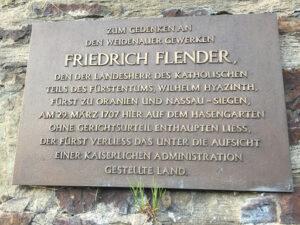
The bronze plaque in the Hasengarten of Siegen’s Upper Castle, where the execution took place. The plaque was mounted in 1957, on the 250th anniversary of his death.
“In memory of the Weidenau ironmaster Friedrich Flender, whom the sovereign of the Catholic part of the Principality—William Hyacinth, Prince of Orange and Nassau-Siegen—had beheaded here at the Hasengarten on March 29, 1707, without a judicial trial. The Prince subsequently departed the territory, which was placed under the supervision of an Imperial Administration”
I found no portrait of him, which is unsurprising since only feudal lords and other very rich people could afford a sitting.
.
.

Leave a Reply